
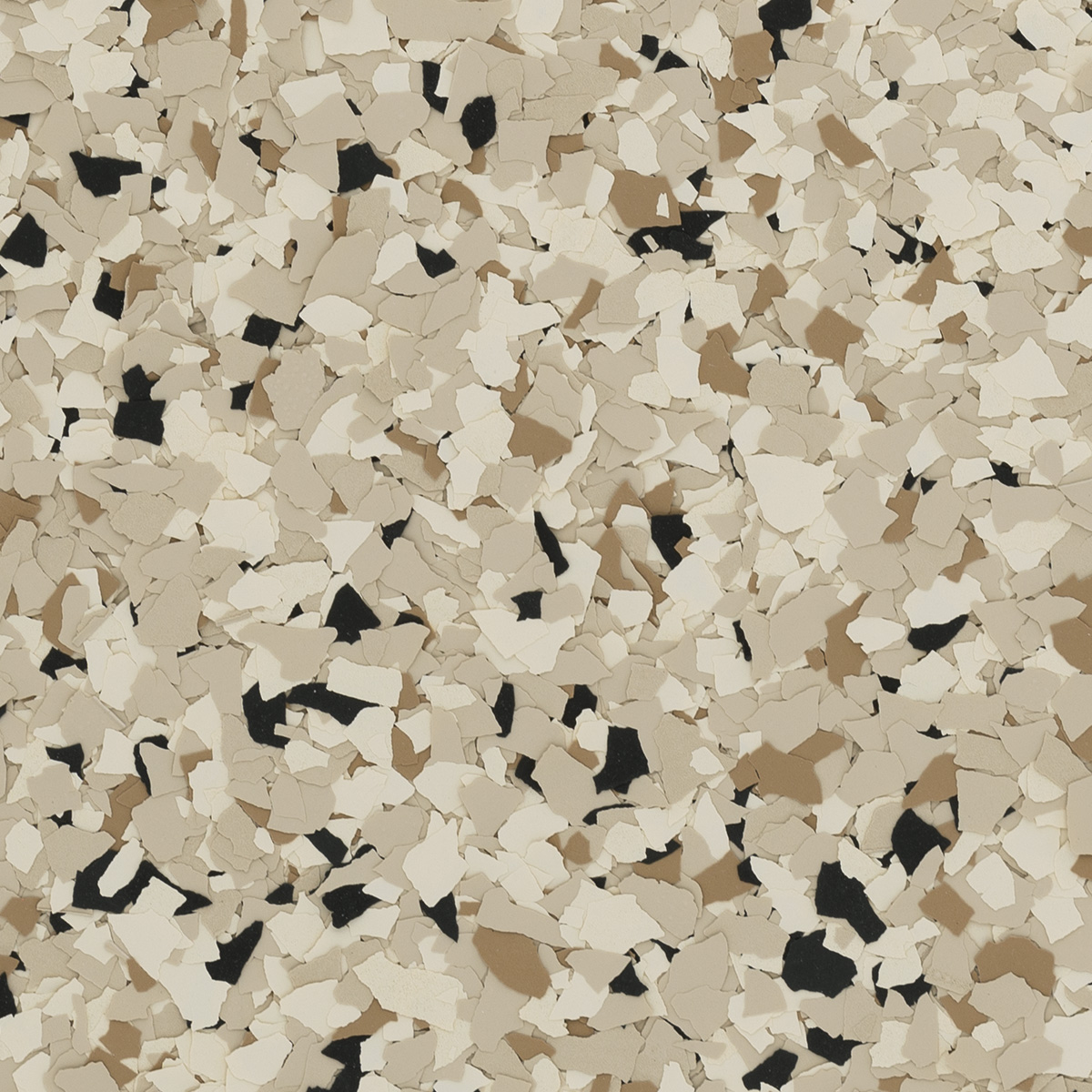
Vinyl flake comes in 1/16″, 1/8″, and 1/4″ sizes, and the right pick depends on the look you want and how much your concrete needs hidden. The 1/4″ flake is the standard for residential garage floors because it covers imperfections, looks like granite from standing height, and is the easiest to install. The 1/8″ flake gives a finer, more contemporary speckle and works well in showrooms or finished spaces. The 1/16″ flake creates an almost solid color with a subtle texture, used mostly in commercial floors or as an accent. For 90% of garage installs, pick 1/4″.
What flake size actually means
Flake size refers to the rough diameter of each piece of vinyl chip after it is ground and screened. A 1/4″ flake is roughly the size of a fingernail clipping. A 1/8″ flake is closer to a sunflower seed. A 1/16″ flake is closer to coarse sand or large salt crystal. All three are made from the same vinyl resin, just screened to different sizes. They share the same chemical resistance, UV stability, and adhesion behavior. The only thing that changes is the visual texture and how much surface they cover per pound.
Coverage per pound by flake size
Coverage shifts with size because smaller pieces pack tighter. Rough numbers for a 40 lb box:
- 1/4″ flake: 400 sq ft at decorative broadcast, 160 sq ft at full reject
- 1/8″ flake: 425 sq ft at decorative broadcast, 175 sq ft at full reject
- 1/16″ flake: 450 sq ft at decorative broadcast, 200 sq ft at full reject
The smaller flakes go slightly farther because more pieces fit per square foot. The trade off is that you cannot really tell a 1/16″ flake from a smooth speckled paint job from more than 6 feet away. The 1/4″ reads clearly as a flake floor.
When to pick 1/4″ flake
The 1/4″ flake is the right choice for a typical garage for five reasons:
- It hides hairline cracks, divots, and minor surface flaws better than smaller sizes.
- It registers visually from standing height. You see the flake pattern, not just color.
- It catches and holds topcoat better, which gives the floor more depth.
- The texture provides natural slip resistance even before you add aggregate.
- It is forgiving during broadcast. Light spots and heavy spots blend in.
If your concrete is older, stained, patched, or has any spider cracks, the 1/4″ flake is genuinely better. The bigger pieces break up the eye line so the brain reads the floor as a pattern instead of looking for flaws.
When to pick 1/8″ flake
The 1/8″ flake makes sense in three scenarios:
- Finished basements, sun rooms, or interior spaces where you want a refined look that reads as decorative concrete rather than commercial garage
- Showroom garages where the floor competes visually with a car you want to be the star of the room
- Commercial retail spaces, gyms, breweries, and similar rooms where a contemporary finish matters
The 1/8″ size also handles full reject installs slightly better because it lays flatter and the topcoat self levels more cleanly across the surface. If you want full reject and a perfectly smooth final feel underfoot, 1/8″ is a strong pick.
When to pick 1/16″ flake
The 1/16″ flake is a specialty product. Use it for:
- Commercial floors where you need slip resistance but want the floor to read as a solid color from a distance
- Accent stripes, border bands, or color washes inside a multi color design
- Industrial spaces with heavy traffic where smaller particles pack tighter and resist gouging
In a residential garage, the 1/16″ flake usually disappoints because customers expect to see a clear flake pattern when they walk in. The smaller chip just does not deliver that visual.
Mixing sizes for a custom look
You can mix sizes in the same broadcast for a layered effect. A common technique is to lay down a 1/4″ flake at 70% of normal coverage, then come back over the wet base with a 1/8″ or 1/16″ fill at 30%. The smaller chips fill the gaps between the bigger ones, which gives the floor depth and visual richness. This is how some custom Insignia Blends are designed. It also extends your topcoat, because a tighter packed surface absorbs less polyaspartic.
How flake size affects topcoat usage
Larger flake sizes change topcoat consumption noticeably. The flake creates surface area that the polyaspartic has to coat. A bigger flake means more vertical edges per square foot, which absorbs more topcoat. Rough numbers for a 400 sq ft garage with two topcoat passes:
- 1/4″ flake at full reject: 2 to 2.5 gallons of polyaspartic
- 1/8″ flake at full reject: 1.8 to 2.2 gallons of polyaspartic
- 1/16″ flake at full reject: 1.5 to 1.8 gallons of polyaspartic
The difference works out to about $30 to $80 in extra topcoat for the larger flake at full reject. At decorative broadcast density, the topcoat difference shrinks to roughly $15 to $30 because there is less flake surface to wrap.
How the size reads at different viewing distances
Visual perception of flake size depends heavily on viewing distance, which most buyers do not think about until after the floor is installed. From 8 feet away (a standing eye line in a garage), each size reads differently:
- 1/4″ flake: clearly visible as individual chips with definite pattern
- 1/8″ flake: visible as a fine speckle, individual chips just barely distinct
- 1/16″ flake: reads as a textured solid color, individual chips not visible
From 3 feet away (kneeling or sitting on the floor):
- 1/4″ flake: every chip clearly defined, almost mosaic looking
- 1/8″ flake: chips clearly visible, finer than 1/4″ but still pattern
- 1/16″ flake: chips visible but small, more like coarse sand
This matters because most photos of flake floors online are shot from 3 to 4 feet above the surface, which makes 1/8″ look bigger than it actually does in real installation. If you only have an internet photo to judge, mentally upgrade to the next size up to match what you will actually see standing in your garage.
Practical recommendation
For a typical residential two-car garage install over decent concrete, pick a 1/4″ flake in a multi color blend like Shoreline, Tuxedo, or River Rock. Order one 40 lb box for decorative broadcast at 400 sq ft, or two 40 lb boxes for full reject. If your concrete is rough or stained, definitely use 1/4″ so the texture does the visual work. If you are coating a finished space inside the house or a showroom, drop to 1/8″. Save the 1/16″ for accents or commercial work.
One last note on broadcast density. A 1/4″ flake at full reject can leave a slightly textured floor that feels grippy underfoot but takes more topcoat to fully encapsulate. Many installers prefer decorative broadcast with 1/4″ because the floor topcoats more smoothly and uses less material overall. The look is still clearly a flake floor, just with more base coat color showing between the chips.
If you are not sure which size suits your space, look at how the same color blend reads in different sizes. Browse the full flake catalog and compare the 1/4″ Amazing Blends against the smaller chip families. The size will usually pick itself once you see the same color in both scales.