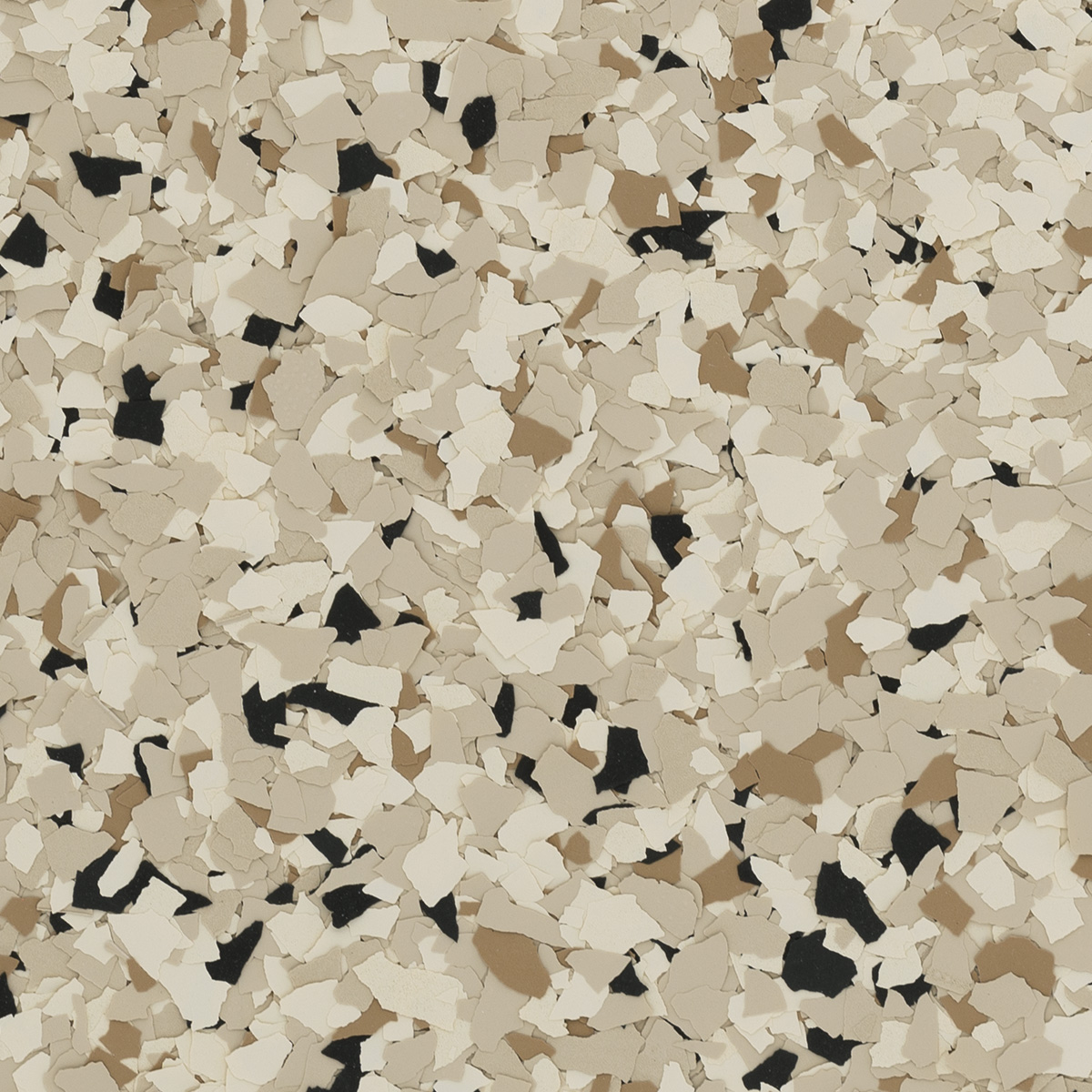
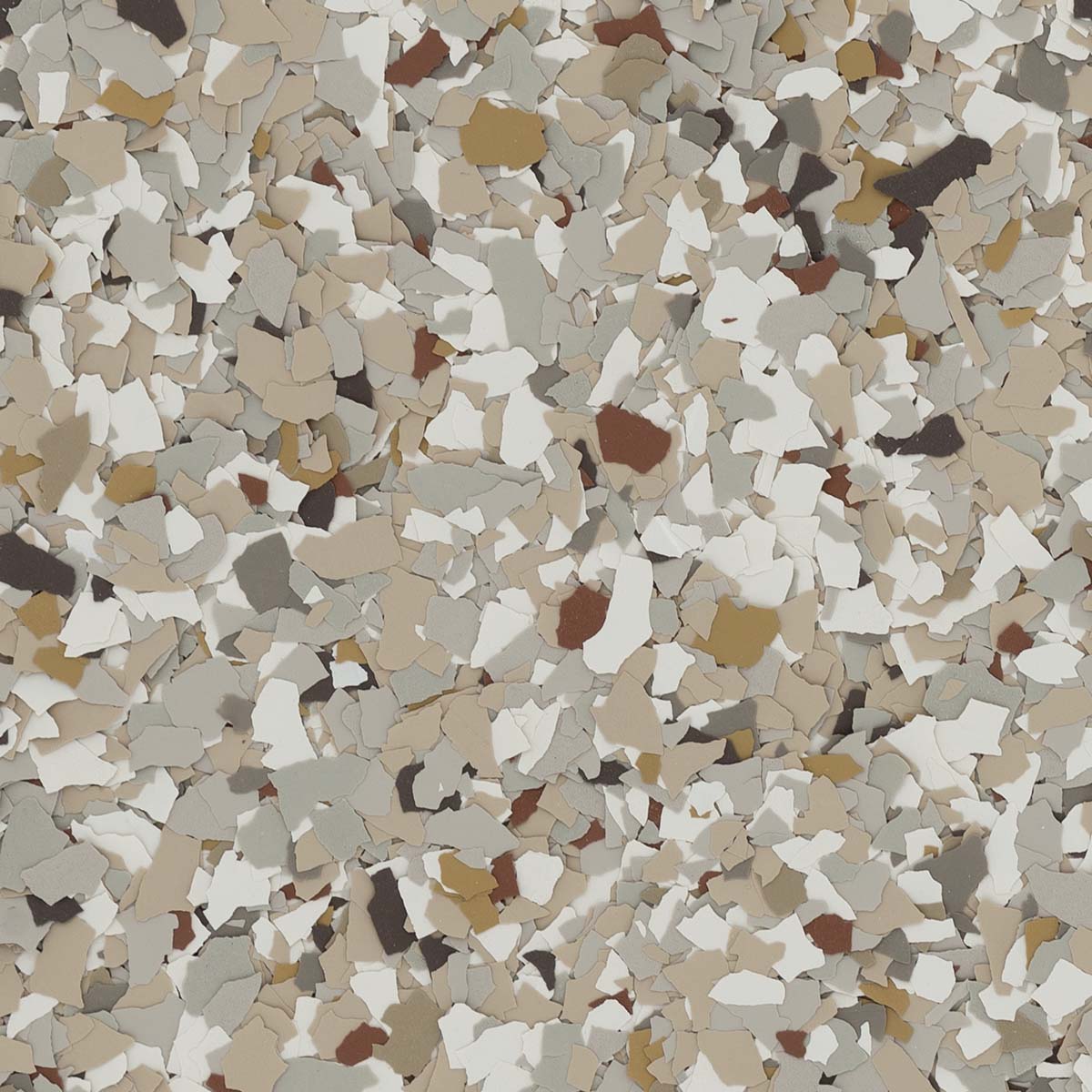
Decorative broadcast covers about 60 to 80 percent of the wet base coat with flake, lets some base color show through, and uses roughly one 40 lb box of flake per 400 sq ft. Full reject (also called full broadcast) covers 100 percent of the base coat, completely hides the base color, and uses about 2.5 times more flake. Decorative broadcast is the better choice when you want a defined flake pattern, lower material cost, and slight texture. Full reject is better when you want a uniform color, a smoother feel underfoot, and the best long term scratch resistance.
What each broadcast method looks like
Decorative broadcast leaves visible base coat color between the flakes. You see the chips as a pattern floating on top of the base. The base color contributes to the overall floor color. A black base with a gray flake blend reads as a darker, richer floor. A gray base with the same flake reads lighter and more uniform. The pattern looks like granite or terrazzo from standing height.
Full reject creates a wall to wall carpet of flake. No base coat shows. The flake color is the floor color. The texture is more uniform and the floor reads as a continuous pattern with no breaks. From a distance, full reject floors look more like commercial flooring or showroom granite. From close up, you can see individual chips overlapping each other.
Coverage and cost difference
The flake math matters because flake is the biggest line item in most floors. For a 400 sq ft two-car garage:
- Decorative broadcast: 1 box of 40 lb flake, around $108 for an Amazing Blend
- Full reject: 2 to 3 boxes of 40 lb flake, around $216 to $324 for the same blend
Full reject also requires more topcoat because the textured surface absorbs more material. Plan on 1.5 gallons of polyaspartic for decorative broadcast and 2 to 2.5 gallons for full reject across the same 400 sq ft.
When decorative broadcast is the right call
Decorative broadcast wins in five common scenarios:
- Budget builds where flake cost matters and you still want a real flake look
- Floors with a stained or patched base where a darker base coat can be used to mask repairs
- Showrooms or workshops where you want the base coat color to play a visual role
- First time DIY installs because decorative broadcast is more forgiving. Light spots and heavy spots blend in.
- Floors with high contrast flake blends where the base color matters to the design
Decorative broadcast also produces a slightly grippier floor because the flake stands a bit more proud of the topcoat. It is not aggressive grip, but it is noticeable barefoot or in slick shoes.
When full reject is the right call
Full reject wins in five different scenarios:
- High end residential installs where the budget supports the extra material
- Showrooms and commercial spaces where a uniform, seamless look matters
- Floors that will see heavy chair rolling, dolly carts, or jack stands because the dense flake layer takes the wear instead of the topcoat
- Installs where you want maximum chip protection. Flake is denser than topcoat, so a thicker flake layer resists scratches better.
- Floors where you want a smoother feel underfoot. The dense flake plus topcoat self levels into a smooth wear surface.
Full reject also gives you long term repairability. If a section of topcoat wears thin in 8 to 10 years, the dense flake layer underneath is still intact and you can simply rebroadcast and recoat without redoing the base.
The mil thickness difference
Broadcast density affects total floor thickness. A typical decorative broadcast floor lands at 22 to 28 mils total thickness. A full reject floor lands at 30 to 40 mils because the flake stack itself adds 8 to 12 mils. That extra thickness is real performance, not just visual. Floors at 30 plus mils handle hot tire pickup, oil spills, and dropped tools better than 22 mil floors.
Hybrid approach: heavy decorative
There is a middle road many installers use. Instead of true decorative broadcast at 60 to 80 percent coverage, push to 85 to 95 percent coverage. You get most of the visual density of full reject, you use about 1.5 to 1.8 boxes of flake per 400 sq ft instead of 2 to 3, and you save real money. The base coat color still slightly influences the floor color, but only as a subtle undertone. This is the sweet spot for many DIY garage installs.
How to broadcast each style correctly
Technique matters more than people expect.
For decorative broadcast, toss flake into the air about 4 to 6 feet above the wet base coat in an arc. Let it rain down. Do not throw it directly at the floor or it lands in clumps. Work in 4 ft by 4 ft sections and overlap edges by 12 inches.
For full reject, broadcast the same way but in two passes. The first pass covers 70 to 80 percent of the base. While the base is still wet, walk the floor with spike shoes and broadcast a second pass to fill every remaining gap. The flake should pile loosely on the surface. Excess flake will be swept up the next day.
How the choice affects future recoats
Recoats happen on most flake floors at the 8 to 12 year mark when the topcoat begins to dull from foot wear. The original broadcast density affects how easy that recoat is.
A decorative broadcast floor recoats easily because the surface is relatively smooth and the topcoat goes on uniformly. Light sanding with a pole sander knocks off the old gloss, then one or two new coats of polyaspartic restore the finish. The flake pattern shows through identically to before.
A full reject floor takes more work to recoat because the heavier flake texture grabs the sander differently and shows any uneven application of new topcoat. Plan on more sanding time and slower roller passes. The end result is still excellent, but the recoat day is closer to 1.5 to 2 times longer than a decorative broadcast floor.
Common broadcast mistakes that ruin the finish
Even with the right method, four mistakes show up regularly on DIY broadcasts:
- Throwing flake directly at the floor instead of upward. The chips land in clumps, on edge, and leave bare spots. Always toss upward and let gravity scatter the chips.
- Broadcasting from one fixed position. You get a heavy circle of flake around your feet and thin coverage further out. Move every 30 seconds to keep coverage even.
- Stopping too early on a decorative broadcast. The floor looks fully covered when wet, but the base coat absorbs and the flake settles, leaving a thinner pattern after cure. Keep going until you see flake clearly resting on top of flake.
- Not sweeping up loose flake before topcoat. Any chip that did not bond will lift during topcoat and create flecks in the clear coat. Sweep, then blower or vacuum the floor before the polyaspartic goes down.
A practical recommendation
For a typical residential garage with decent concrete, decorative broadcast at 85 to 90 percent coverage is the best value. You get a clear flake pattern, the floor reads as decorative without looking sparse, and you only need one to one and a half boxes per 400 sq ft. Save full reject for commercial work, showrooms, or premium residential installs where the extra $150 to $200 in flake plus topcoat is a non issue.
To plan your broadcast, work out your square footage first, then pick your blend. Most of the Amazing Blends read beautifully at both decorative broadcast and full reject, so the choice comes down to budget and the feel you want underfoot.